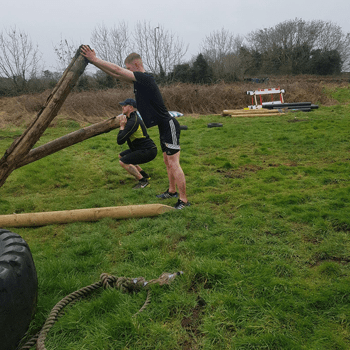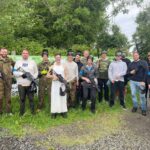


4th Newtownabbey Boys’ Brigade, our Juniors finished their regular Summer Programme on Monday with a fantastic night at Forest Fitness NI in Carrick.
About Us
4th Newtownabbey Boys’ Brigade at the Carnmoney church. For over 360 years, Carnmoney Church has stood as a beacon of faith and community — its roots stretching back to 1657, and even earlier to a meeting house established in 1622. As one of the oldest Presbyterian churches in Ireland, its legacy is woven into the spiritual fabric of this land, continuing to impact lives through generations of worship, witness, and unwavering hope.
History of the Boys Brigade
.jpg)
The Boys’ Brigade was founded in Glasgow by Sir William Alexander Smith on 4 October 1883 to develop Christian manliness by the use of a semi-military discipline and order, gymnastics, summer camps and religious services and classes.[7]
By 1910, there were about 2,200 companies connected with different churches throughout the British Empire and the United States, with 10,000 officers and 100,000 boys.[7]
Boys’ Brigade Scouts, 1906–1927
Companies of The Boys’ Brigade used manuals on scout training in their programmes. In May 1903, Robert Baden-Powell became a vice-president.[8] Baden-Powell promoted the idea of scouting and outdoor pursuits in the Boys’ Brigade and other boys’ organisations and schools.[9] The Boys’ Brigade formally began its Boy Scout scheme in 1906. Scout badges, Silver second class & Gold first class, were awarded in The Boys’ Brigade.[10]
There were specialised Boys’ Brigade Scout sections, which operated as part of a BB Company. They met at different times to train in scouting, who wore khaki or blue uniforms, neck scarves and the distinctive four-dented, broad-brimmed fur felt hats.[11] Boys of the Bournemouth & Poole Battalion of The Boys’ Brigade participated in Baden-Powell’s experimental camp on Brownsea Island in 1907. Baden-Powell did not originally intend to start a separate organisation.[9]
Many Boys’ Brigade Scouts later made dual registration with The Boy Scouts Association. The 1st Bournemouth Scouts was run by the 1st Bournemouth Boys’ Brigade as a ‘BP’ Scout group and never a ‘BB Scout ‘Section. The Boys’ Life Brigade, which merged with The Boys’ Brigade in 1926, operated its own Boy Scouts and was a member organisation of the National Peace Scouts with the British Boy Scouts.[12]
The Boys’ Brigade Scouts continued until 1927. Some former Boys’ Brigade Scout units continued independently after 1927, or affiliated with The Boy Scouts’ Association or British Boy Scouts. Two of the original Boys’ Brigade Scout units continue as 1st Parkstone Scout Group and 1st Hamworthy Scout Group, both formerly sub-units of the 1st Poole Boys Brigade.